
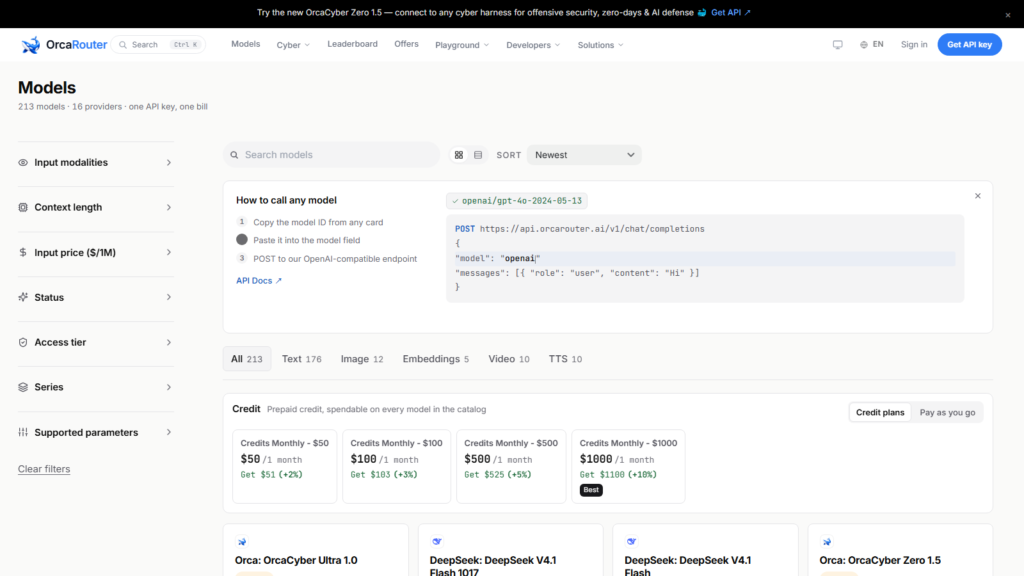
The OrcaRouter AI API models page says 200+ in its title, its headline and its FAQ. Ask the API the same question and you get a number instead of a slogan: the public model list returns 209 identifiers across nineteen prefixes [OURS, read 2026-10-21].
209 is a strange number to arrive at deliberately. It is not 200, it is not 210, and it is nine more than the round figure every page repeats. That gap is what this article is about: what the catalogue actually contains, how the two largest families account for half of it, and why the count moves without anybody announcing it.
The nineteen prefixes
| Prefix | Count | Prefix | Count | |
| `openai` | 76 | `kimi` | 4 | |
| `google` | 29 | `tencent` | 4 | |
| `qwen` | 27 | `orcarouter` | 4 | |
| `anthropic` | 12 | `obsidian` | 3 | |
| `deepseek` | 11 | `orca` | 3 | |
| `z-ai` | 10 | `meta` | 2 | |
| `kling` | 8 | `typesafe` | 1 | |
| `minimax` | 6 | `codex-auto-review` | 1 | |
| `grok` | 5 | `gpt-5.6-luna` | 1 | |
| `gpt-image-2.5-flare` | 1 | |||
| `gpt-image-2.5-sunburst` | 1 |
The first three prefixes — openai, google, qwen — account for 132 of 209, or 63 percent. Add anthropic and deepseek and you are at 155, just under three quarters of the catalogue. The remaining fourteen prefixes share the last 54 entries.
The last three entries in that table are the ones a reader should pause on. `codex-auto-review`, `gpt-5.6-luna`, `gpt-image-2.5-flare` and `gpt-image-2.5-sunburst` are identifiers with no slash at all, so they cannot be grouped into a prefix. An internal review model and three image models sit at the top level of the catalogue, and a naive parser that splits on `/` will drop them or crash.
That is not a curiosity; it is a compatibility fact. If your client builds a provider list by splitting identifiers, you will report sixteen providers on a catalogue that has nineteen.
What the 209 actually contains
The count is not 209 chat models. It is 209 endpoints, and the mix is broad.
Text-to-speech and audio: the OpenAI catalogue carries four character-billed TTS rows and three token-billed ones, Google carries three TTS rows and a robotics model, and MiniMax carries an audio entry.
Image generation: Google’s five per-request image rows plus a token-billed Nano Banana and two imagen TTS-class variants; OpenAI’s four image rows; a Grok image row.
Embeddings: three OpenAI text embeddings and two Google ones.
Video and audio generation: the Kling eight, the Tencent four and the MiniMax video entry.
Free-tier identifiers: seven, spread across DeepSeek, Z.ai, Tencent, Orca and the gateway’s own `orcarouter/free`.
So “200+ models” is a claim about endpoint breadth, not about the number of frontier chat models. The number of things you could route a conversation to is smaller; the number of things you could call is 209.
Why the number moves
A catalogue of this size changes daily, and none of the changes announce themselves through the number on the page. Three mechanisms account for most of the movement.
Aliases. Rows like `google/gemini-pro-latest` resolve to whichever model currently holds the name. Adding or retiring a target does not change the count of identifiers; it changes what one identifier does.
Dated snapshots. Twenty of the 76 OpenAI rows carry a date suffix and are frozen copies of a sibling. A provider that freezes a snapshot adds a row without adding a model.
Per-request and per-second models. An image or a video model is an endpoint with a price and a name, and it belongs in a catalogue of callable things while not being a chat model in any usual sense.
The practical consequence is that the number is a good measure of breadth and a poor measure of choice. If you are picking a chat model, 209 is the wrong denominator; 76 of them are OpenAI, and the meaningful shortlist is a few dozen.
The count and the price page
One more check makes the number concrete. The site’s own provider listing, visible in the footer of every provider page, prints the counts per family: OpenAI 76 · Google 30 · Qwen 27 · Anthropic 13 · DeepSeek 11 · Z.ai 10 · Kling 8 · MiniMax 6 · Grok 5 · Kimi 4 · Tencent 4 · Obsidian 3 · Orca 3 · Meta 2 · Typesafe 1.
Two of those differ from the API’s own count: Google 30 against 29, Anthropic 13 against 12 [OURS]. Both discrepancies are one, and both are in the direction of the page counting a row the API does not list.
That is worth knowing before you build anything on either number. The page’s counts are merchandising; the API’s list is what a client can call. Where they disagree, the API is the answer.
What a wide catalogue is good for
The point of 209 endpoints behind one key is not variety for its own sake. It is that three different decisions can be made from one place.
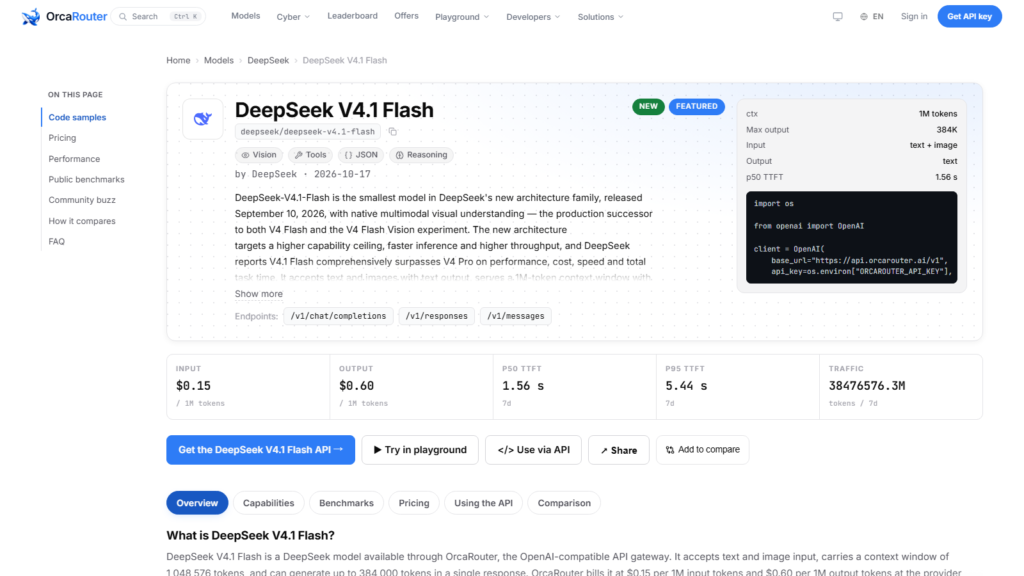
A model swap costs one string. Changing `openai/gpt-6-sol` to `deepseek/deepseek-v4.1-flash` is an edit to the `model` field, not an integration. The base URL, the SDK, the auth and the response shape stay the same.
A comparison costs one afternoon. The catalogue publishes context, pricing and quality columns for every row. Reading 209 rows is not feasible; reading the twelve rows that fit your constraints is.
A failover chain costs a config line. With a catalogue this wide, a fallback chain across providers is drawn from a large pool rather than from a handful.
The number that matters is not 209; it is the number of rows that fit your constraints. On a catalogue this broad, that is usually under ten — and finding them is the actual work.
How to count a catalogue properly
Four habits.
Ask the API, not the page. A marketing figure and a list endpoint answer different questions, and where they disagree the endpoint is what your client will see.
Group by prefix, then handle the exceptions. Sixteen prefixes cover 205 of the 209 identifiers; four have no prefix at all and belong to a separate bucket.
Separate endpoints from models. TTS, image, embedding and video entries are callable things with prices, and they are not candidates for a chat shortlist.
Re-count before you quote. The number moves daily through aliases, snapshots and new releases, and none of the movement is announced. A figure quoted from memory is a figure from a different week.
A catalogue advertised as 200+ and measured at 209 is not a discrepancy worth an article on its own. What is worth the article is that the same measurement tells you the catalogue’s shape — three families at the top, four prefix-free entries, and a count that changes without a changelog.